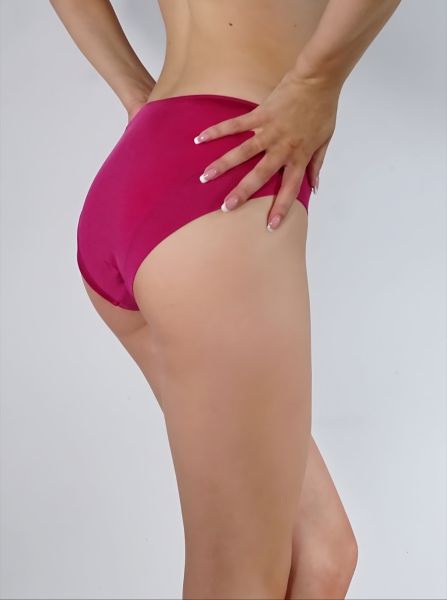


A women's bodysuit lives in the space between underwear and a top — and that is exactly where its strength lies. It is not simply underwear and not simply a top. It is the style that fulfils both roles — and does so better than anything else. That versatility makes it practical, adaptable and genuinely indispensable in a way few other garments can claim.
The advantages of the women's bodysuit
The key difference between a bodysuit and every other underwear or top style is one thing: it fastens at the bottom. That single feature makes it the garment that always stays in place.
Because it is precisely the fastening that makes a bodysuit irreplaceable. It doesn't ride up, doesn't come untucked from trousers, doesn't bunch under a blazer and doesn't need constant adjusting. On an active day, through long meetings, during movement — a bodysuit stays exactly where it needs to be. No attention required, no compromise.
The second advantage is the silhouette. A bodysuit sits against the body smoothly and evenly — no excess fabric, no folds, no visible layer under clothing. Under fitted trousers, under a high-waisted skirt or under a formal suit it is invisible and flawless. Where a tank top or camisole would bunch or show, a bodysuit simply disappears.
The third advantage is versatility. The same bodysuit can sit under a jumper in the morning fulfilling the role of underwear, and in the evening become a top in its own right when the jumper or cardigan comes off.
The women's bodysuit — underwear, top or both
As underwear, a bodysuit works best under fitted clothing, under formal outfits and in any situation where the outer garment calls for a smooth, clean silhouette underneath. A microfiber bodysuit with thin straps is the classic choice for this role — smooth, with fine seams, invisible even under the finest knit. A cotton bodysuit is the alternative when a more natural fabric and better breathability are needed.
As a top, a bodysuit is a different story. A tulle bodysuit with lace detailing, a cotton bodysuit with a striking neckline or a long-sleeve style with an open back — each of these is a standalone garment, not a layer beneath something else. With wide-leg trousers and heeled shoes, with jeans and trainers, with a skirt and a blazer — a bodysuit as a top works in every combination a blouse would, but with a significantly cleaner silhouette and no unwanted folds.
The styles that work in both roles are perhaps the most valuable in the wardrobe — the perfect choice and a sound investment. These are the styles that solve several problems across many situations and require less thought when getting dressed.
A cotton bodysuit with a V-neckline and thin adjustable straps — in the morning it sits under a jumper, at lunch under an open blazer, in the evening it becomes a standalone top when the cardigan comes off. Nothing has changed except the layers around it. A tulle bodysuit with lace detailing — under a formal shirt it is a delicate inner layer; without the shirt it is an expressive top for the evening. A long-sleeve bodysuit with an open back — under a wide blazer it is a warm, practical layer; with trousers alone it makes a statement.
This flexibility is particularly valuable when travelling or on days with a full schedule — when there is neither time nor opportunity to change outfits entirely between the different parts of the day. A bodysuit adapts to the context around it — and that is exactly what makes it indispensable where other garments require replacement.
The practicality of a versatile style is felt in the wardrobe too — fewer pieces, more combinations. One well-chosen bodysuit replaces a tank top, a camisole and a blouse at the same time. For women with an active lifestyle or a minimal approach to their wardrobe, it is the ideal garment.
How to choose the right style
Neckline is the first decision. A V-neckline is the most versatile — it works under open-collar shirts and as a standalone top. A round neckline is more discreet and better suited under closed garments. A deep neckline is for wearing as a top, not beneath other clothing.
Sleeve determines the season and the application. A sleeveless bodysuit is the universal solution — it can have thin or wider straps, works year-round as an underlayer and in warm weather as a standalone top. A short-sleeve bodysuit adds a little coverage without warmth. A long-sleeve bodysuit is for cooler months and for wearing as a top with character.
Fabric determines the feel and the application. Microfiber is for invisibility and smoothness under clothing. Cotton is for comfort and breathability. Tulle and lace are for visibility — they are not meant to be hidden; they are meant to be seen.
Size with a bodysuit is more critical than with most other garments. The bottom fastening requires a precise fit — too small and it pulls and is uncomfortable; too large and it won't fasten correctly and loses its purpose entirely. Styles with thin straps must always have adjustable strap length. When choosing between two sizes, consult the size chart and measure at the hip, not the waist.
Bodysuits at SIA Underwear
In the women's bodysuit collection at SIA Underwear you will find styles for every role — bodysuits as underwear for wearing under clothing and bodysuit tops for wearing as a standalone top, with short and long sleeves, in cotton, microfiber, tulle and lace — in sizes S to 6XL, made in Bulgaria.
A bodysuit is not simply underwear and not simply a top. It is the style that does both — and does it better than anything else.
The advantages of the women's bodysuit